Dear readers,
As the Center for Social Research, we are once again experiencing the pride and excitement of meeting with you through the May 2025 issue of our international peer-reviewed social sciences journal, Journal of TAM Academy. As in every issue, we have included studies that trace interdisciplinary approaches, innovative thoughts, and in-depth analyses. These articles, which once again demonstrate how valuable it is to be able to look at the issues of our age from different perspectives in the broad and dynamic universe of social sciences, will undoubtedly make significant contributions to their fields.
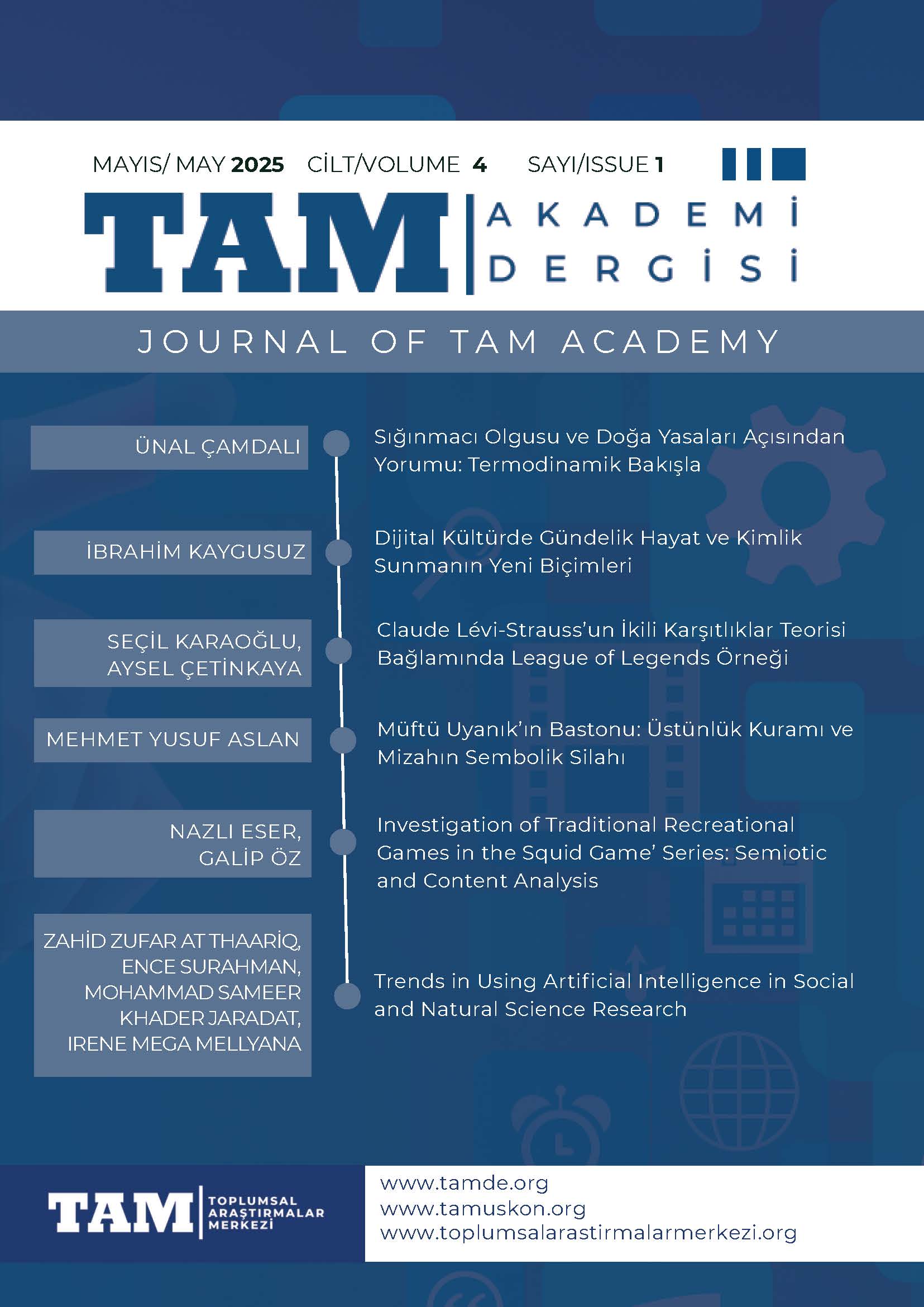
In the first article of this issue, Ünal Çamdalı interprets the refugee phenomenon, which is at the center of the social and political agenda, from a thermodynamic perspective. This study, which is a beautiful example of an interdisciplinary approach, builds an interesting and thought-provoking bridge between natural laws and social phenomena.
İbrahim Kaygusuz's study focuses on how individuals reconstruct their daily lives and present their identities in digital culture. This article, which addresses the increasing influence of digital media in contemporary societies, contributes to our understanding of the transformation of digital identity.
The collaborative work of Seçil Karaoğlu and Aysel Çetinkaya examines the universe of League of Legends, a popular digital game, within the framework of Claude Lévi-Strauss's binary oppositions theory. This original relationship established between cultural theory and digital game culture presents noteworthy findings from both anthropological and media studies perspectives.
Mehmet Yusuf Aslan's article titled " Müftü Uyanık’ın Bastonu: Üstünlük Kuramı ve Mizahın Sembolik Silahı" analyzes the sociological function of humor within the framework of "superiority theory" while revealing the power of symbols and cultural images.
Nazlı Eser and Galip Öz examine the traditional games in the Squid Game series through semiotic and content analyses, attempting to analyze how contemporary media products refer to cultural codes. This study makes an important contribution to understanding the interaction between global culture and local elements.
Finally, the collaborative work of Zahid Zufar At Thaariq, Ence Surahman, Mohammad Sameer Khader Jaradat, and Irene Mega Mellyana examines the usage trends of artificial intelligence in social and natural sciences. This current and comprehensive analysis serves as a guide for understanding the transformation of research methods.
Each article featured in this issue reflects the polyphonic structure of Journal of TAM Academy with both its theoretical richness and original contribution. On behalf of all my colleagues on the editorial board, I thank our authors for their efforts and wish our valued readers an enjoyable and productive reading experience.
Best regards,
Prof. Mustafa Yılmaz
Editor-in-Chief