Dear Readers,
As the Center for Social Research (TAM), we are pleased to present to you the November 2025 issue of our international peer-reviewed social sciences journal, the Journal of TAM Academy. In the dynamic world of the social sciences, the intersections of different disciplines have always served as the most fertile grounds for intellectual production. This issue represents precisely such an intersection: from the climate crisis to digital Islamophobia, from development policies to media ownership structures, and from ancient Hittite beliefs to contemporary literary analysis, it offers multifaceted perspectives on the pressing challenges of our time.
As a journal that believes academic production is enriched not only by knowledge accumulation but also by the dialogue between diverse perspectives, we continue in this issue to pursue original research and in-depth analysis. Each article fills a significant gap in its respective field and makes a meaningful contribution to the polyphonic nature of the social sciences.
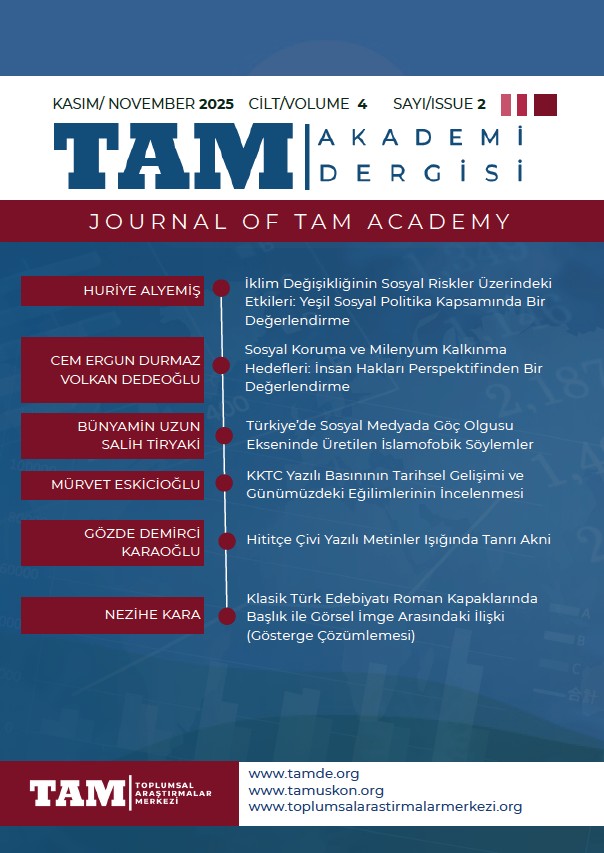
In the first article of this issue, Huriye Alyemiş Güripek examines the social risks posed by climate change and demonstrates the necessity of the green social policy approach. Addressing environmental sustainability and social equality through an integrated perspective, this study offers a new social policy paradigm for confronting the climate crisis.
The joint work of Cem Ergün Durmaz and Volkan Dedeoğlu evaluates the potential strategic contribution of social protection mechanisms to the Millennium Development Goals from a human rights perspective. Highlighting the critical role of social protection in combating poverty and social risks, this article adds conceptual and empirical depth to global development goals.
The study by Bünyamin Uzun and Salih Tiryaki analyzes Islamophobic discourse emerging on social media platforms in Turkey within the context of migration and anti-immigrant sentiment. Employing a netnographic method to explore digital processes of othering, this article reveals the manifestations of nationalist attitudes and religion-based discrimination in digital spaces.
In her article, Mürvet Eskicioğlu examines the historical development and current ownership structures of the print media in the Turkish Republic of Northern Cyprus, revealing the media’s relationship with political and economic dynamics. By highlighting the distinctions between advocacy journalism, propaganda journalism, and peace journalism, the study sheds light on the multilayered structure of the Turkish Cypriot press.
Gözde Demirci Karaoğlu investigates the representations and religious function of the deity Akni mentioned in Hittite cuneiform texts. Exploring how this divine figure—associated with concepts of death, destruction, and catastrophe—was ritually controlled, the study provides valuable insights into ancient Anatolian belief systems.
Finally, Nezihe Kara analyzes the relationship between title and visual imagery on the covers of classical Turkish novels through a semiotic approach. Questioning how linguistic and visual signs are interpreted, this original study draws attention to the visual dimension of literary communication.
Each article included in this issue reflects the richness and originality of the Journal of TAM Academy and its commitment to multi-voiced academic inquiry. We wish our esteemed readers an enjoyable and fruitful reading experience.
Best regards,
Editorial Board of the Journal of TAM Academy